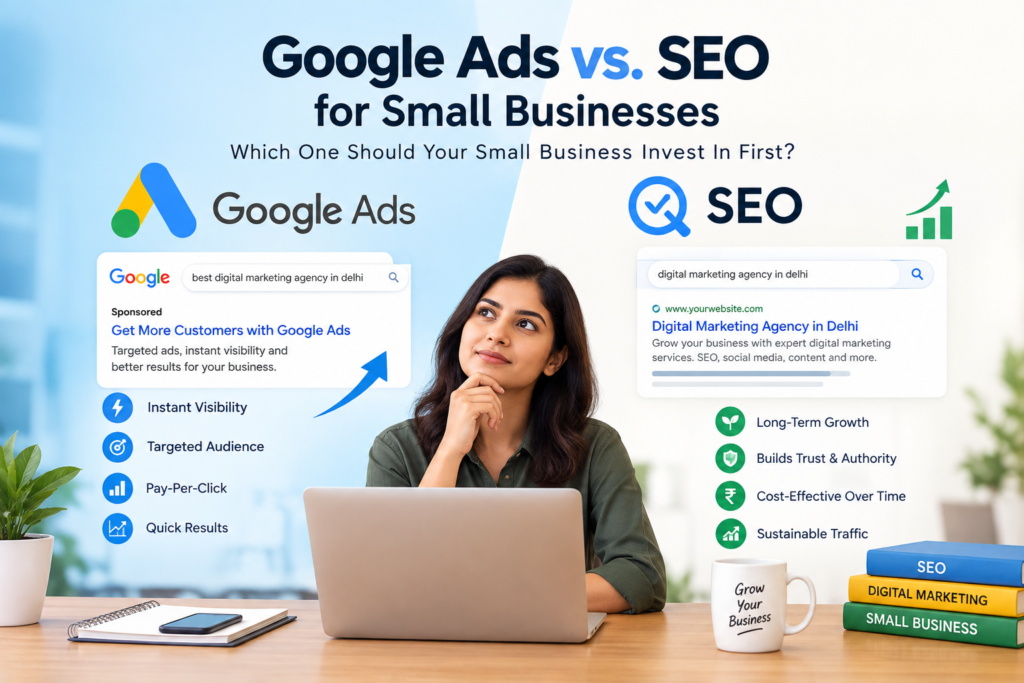
For small businesses, deciding where to spend a limited marketing budget can be challenging. Should you invest in Google Ads to generate traffic quickly, or focus on SEO to build organic visibility over time? Understanding google ads vs seo for small businesses can help you choose a strategy based on your goals, budget, competition, and growth plans.
Both approaches can bring potential customers to your website, but they work differently. Google Ads can put your business in front of people searching for relevant products or services through paid placements, while SEO focuses on improving your website’s organic visibility in search results.
There is no single strategy that works for every business. The right choice depends on what you need your marketing to accomplish.
What Is Google Ads?
Google Ads is a paid advertising platform that allows businesses to display advertisements when people search for relevant products, services, or keywords. You generally pay when someone interacts with your advertisement, depending on the campaign type and bidding model.
For small businesses, Google Ads can be useful when you want to generate targeted website visits, calls, enquiries, bookings, or sales within a relatively short period.
For example, a local plumbing company could target searches related to emergency plumbing services in its service area. A person actively searching for that service may see a relevant advertisement and contact the company.
This immediate visibility is one of the major differences when considering google ads vs seo for small businesses.
What Is SEO?
Search engine optimization, or SEO, involves improving your website and online presence so that search engines can better understand and rank your content for relevant searches.
An effective SEO strategy can include:
- Keyword research
- Helpful website content
- Technical SEO
- Website speed optimization
- Internal linking
- Local SEO
- Mobile optimization
- Quality backlinks
- Google Business Profile optimization
Unlike paid advertising, organic search traffic does not require paying for every individual click. However, SEO requires consistent work and time to build visibility.
This makes google ads vs seo for small businesses an important consideration for companies deciding between immediate traffic and long-term organic growth.
Google Ads vs SEO: Speed
One of the biggest differences between the two strategies is how quickly they can generate visibility.
Google Ads can potentially start generating impressions and clicks after a campaign becomes active and eligible to serve. This makes paid advertising useful for businesses launching a new service, promoting an offer, or testing demand.
SEO generally takes longer because search engines need to discover, evaluate, and rank your content. Results can depend on your website’s authority, competition, content quality, technical setup, and search intent.
Therefore, when evaluating google ads vs seo for small businesses, consider whether your priority is immediate visibility or building organic visibility over time.
Google Ads vs SEO: Cost
Cost is another major factor.
With Google Ads, you establish a budget and pay for advertising interactions according to your campaign setup. Your costs can vary depending on competition, keywords, location, audience, industry, and campaign performance.
SEO works differently. You may spend money on content creation, technical optimization, SEO tools, link building, or professional SEO services. The investment is usually focused on improving your website and organic visibility rather than paying directly for every click.
When comparing google ads vs seo for small businesses, remember that neither strategy is automatically inexpensive. The cost depends heavily on how well the campaign or SEO program is planned and managed.
Which One Provides Better Long-Term Value?
SEO can become an important long-term marketing asset because useful content and optimized pages can continue attracting organic visitors after they are published.
For example, a well-optimized article answering a common customer question may continue receiving search traffic months after publication.
Google Ads, on the other hand, provides paid visibility while campaigns are running and within the applicable budget and campaign settings.
This distinction is important when considering google ads vs seo for small businesses. SEO may support long-term organic growth, while Google Ads can provide a more direct way to reach people through paid search.
When Should a Small Business Consider Google Ads?
Google Ads may be worth considering when your business:
- Needs traffic or enquiries relatively quickly
- Has a clear advertising budget
- Offers products or services people actively search for
- Wants to promote a specific offer
- Is launching a new service
- Wants to test keyword or market demand
- Has conversion tracking properly configured
For example, a local business with a new service could use Google Ads to test whether specific search terms generate enquiries before investing heavily in additional marketing activities.
This is one practical way to approach google ads vs seo for small businesses without treating the two strategies as completely separate choices.
When Should a Small Business Focus on SEO?
SEO may be particularly useful when your business wants to:
- Build sustainable organic visibility
- Publish educational content
- Target local searches
- Reduce reliance on paid traffic over time
- Establish topical authority
- Attract customers throughout different stages of the buying journey
For local businesses, SEO can also involve optimizing Google Business Profile information, creating location-specific content, collecting genuine customer reviews, and improving local website signals.
A well-planned SEO strategy can therefore become an important part of google ads vs seo for small businesses planning.
Can You Use Google Ads and SEO Together?
Yes. In many cases, businesses can use both strategies as part of their overall digital marketing plan.
For example, Google Ads can help generate immediate visibility while your SEO strategy is being developed. At the same time, data from paid campaigns can provide useful insights into which keywords, offers, and landing pages attract customer interest.
SEO can then help build organic visibility around valuable topics and services.
This combined approach makes google ads vs seo for small businesses less about choosing one permanent winner and more about allocating resources according to business goals.
How to Decide Which Strategy Fits Your Business
Before choosing between Google Ads and SEO, ask yourself these questions:
Do you need customers quickly?
If immediate visibility is important, paid advertising may be worth considering.
Can you invest consistently over time?
SEO generally requires ongoing content, technical improvements, and optimization.
What is your competition like?
Highly competitive keywords may require substantial effort, whether you use paid or organic strategies.
Can you track conversions?
Before spending money on advertising, make sure you can measure calls, forms, purchases, bookings, or other meaningful actions.
What is your marketing budget?
Consider both the immediate costs and the resources required to maintain the strategy.
These questions provide a practical framework for evaluating google ads vs seo for small businesses based on your individual circumstances.
Final Thoughts
The decision between Google Ads and SEO does not have to be an either-or decision. Google Ads can provide paid visibility and help businesses reach relevant searchers, while SEO can support long-term organic visibility and content-driven growth.
When evaluating google ads vs seo for small businesses, consider your budget, business goals, competition, timeline, customer search behavior, and ability to measure results.
For some businesses, starting with paid search may make sense while building an SEO foundation. For others, investing consistently in SEO may align better with their long-term marketing objectives. Many businesses can also combine both approaches and adjust their investment based on measurable performance.
The most important step is to build a strategy around your actual business goals rather than choosing a channel simply because it is popular.
https://getgigwise.in/ can help small businesses develop a digital marketing strategy covering SEO, paid advertising, website optimization, and online growth.