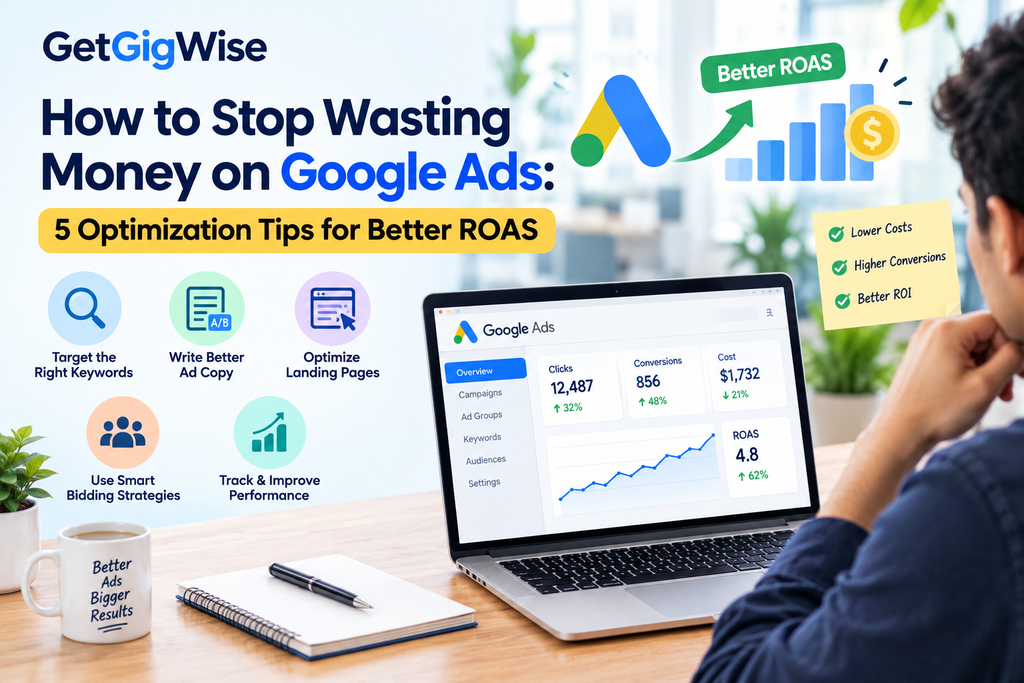
Running Google Ads can help small businesses reach potential customers when they are actively searching for relevant products and services. However, simply launching a campaign does not guarantee profitable results. Without regular monitoring and Google Ads optimization, businesses can spend money on irrelevant searches, poorly targeted audiences, weak landing pages, and campaigns that generate clicks without enough conversions.
The goal of Google Ads should not simply be to generate more traffic. The goal is to generate valuable actions from the right customers while using your advertising budget efficiently.
If your campaigns are receiving clicks but producing few enquiries, sales, or bookings, it may be time to review your strategy. Here are five practical Google Ads optimization tips that can help reduce wasted spending and improve your return on ad spend.
1. Use Negative Keywords to Reduce Wasted Clicks
One of the simplest ways to improve Google Ads optimization is to control which searches can trigger your advertisements.
Even when you select relevant keywords, your ads may sometimes appear for searches that are not valuable to your business. For example, a company selling premium professional services may receive clicks from people searching for free solutions, jobs, courses, tutorials, or unrelated services.
These clicks can consume your advertising budget without producing meaningful business results.
Negative keywords allow you to tell Google which searches you don’t want your ads to appear for.
What to look for
Review your search terms regularly and identify searches that:
- Are unrelated to your service
- Attract people looking for free products
- Target the wrong location
- Show employment or educational intent
- Represent products or services you don’t offer
- Generate clicks but no meaningful actions
Adding appropriate negative keywords can help make your campaigns more focused.
This is an important part of Google Ads optimization because reducing irrelevant traffic allows more of your budget to reach searches that are relevant to your business.
2. Focus Your Budget on High-Performing Campaigns and Keywords
Not every keyword or campaign contributes equally to your results.
Some keywords may generate conversions consistently, while others produce clicks without generating enquiries or sales. If you distribute your budget equally across everything, you may end up spending too much on underperforming areas.
Effective Google Ads optimization involves reviewing performance and identifying where your advertising budget is actually producing valuable results.
Look at metrics such as:
- Click-through rate
- Cost per click
- Conversions
- Cost per conversion
- Conversion rate
- Conversion value
- Return on ad spend
Instead of focusing only on clicks, examine what happens after someone clicks your advertisement.
For example, a keyword that generates 100 inexpensive clicks but zero enquiries may be less useful than a keyword that generates 20 clicks and several qualified leads.
Your objective should be to understand which parts of your account contribute to business outcomes and adjust your budget accordingly.
3. Improve Your Ad Copy and Match Search Intent
Getting someone to click your advertisement is only the beginning.
Your ad needs to communicate why the searcher should choose your business. If the message is vague or doesn’t match what the person searched for, you may attract low-quality traffic or lose potential customers.
Strong Google Ads optimization includes improving the connection between the keyword, advertisement, and landing page.
For example, if someone searches for “local SEO services for small businesses,” an advertisement specifically discussing local SEO services is likely to be more relevant than a generic advertisement about digital marketing.
Your ad copy should clearly communicate:
- What you offer
- Who you serve
- A relevant benefit
- What makes your offer useful
- A clear next step
Different businesses can test different messaging to determine which advertisements generate better engagement and conversions.
However, don’t optimize solely for clicks. A highly attractive advertisement that generates many clicks but few conversions may not improve your overall ROAS.
4. Optimize Your Landing Pages
You can have well-targeted keywords and excellent advertisements, but your campaign can still waste money if the landing page doesn’t deliver a good experience.
When someone clicks an advertisement, the landing page should make it easy for them to understand the offer and take the desired action.
This is another essential part of Google Ads optimization.
Your landing page should ideally:
- Match the advertisement’s message
- Explain the service or product clearly
- Load quickly
- Work well on mobile devices
- Use a clear headline
- Include a prominent call-to-action
- Provide relevant trust signals
- Avoid unnecessary distractions
For example, if your advertisement promotes a specific service, sending the visitor to a generic homepage may create unnecessary friction.
A dedicated landing page focused on that service can provide a more relevant experience.
Also pay attention to your forms. If a form asks for too much information, potential customers may abandon it before submitting.
Improving the post-click experience can help turn more of your paid traffic into meaningful business actions.
5. Track Conversions and Optimize for Business Results
One of the biggest mistakes businesses make with Google Ads is judging performance based only on impressions, clicks, or traffic.
These metrics can tell you what people are doing before they convert, but they don’t necessarily tell you whether your advertising is generating business value.
Proper conversion tracking is therefore fundamental to Google Ads optimization.
Depending on your business model, valuable conversions could include:
- Completed purchases
- Lead form submissions
- Phone calls
- Appointment bookings
- Quote requests
- Sign-ups
- Contact requests
Once conversions are being tracked properly, you can compare campaigns, keywords, advertisements, and landing pages based on actual outcomes.
This makes it easier to identify where your advertising budget is working and where adjustments may be necessary.
For businesses focused on ROAS, tracking revenue or conversion value can provide an even clearer picture of campaign performance.
How to Improve Your Google Ads ROAS
Return on ad spend, or ROAS, compares the value generated by advertising with the amount spent on advertising.
For example, if a campaign generates ₹50,000 in tracked revenue from ₹10,000 in advertising spend, the ROAS would be 5x.
However, ROAS should always be interpreted in the context of your business. Revenue is not the same as profit, and different businesses have different margins, customer values, and operating costs.
Improving ROAS therefore requires looking beyond individual clicks.
Effective Google Ads optimization can involve improving targeting, reducing irrelevant searches, refining advertisements, improving landing pages, adjusting budgets, and strengthening conversion tracking.
How Often Should You Optimize Google Ads?
Google Ads optimization shouldn’t necessarily mean changing everything every day.
Making too many changes without enough performance data can make it difficult to understand what actually improved or hurt your results.
Instead, establish a regular review process.
For example, you can regularly examine:
- Search terms
- Keyword performance
- Conversion data
- Budget allocation
- Ad performance
- Landing page results
- Geographic performance
- Device performance
The frequency of review depends on your campaign size, budget, conversion volume, and business goals.
The key is to make informed changes based on meaningful data rather than reacting to every short-term fluctuation.
Final Thoughts
Wasting money on Google Ads isn’t always caused by high click costs. In many cases, the problem comes from poor targeting, irrelevant searches, weak advertisements, ineffective landing pages, or inadequate conversion tracking.
A structured Google Ads optimization process can help businesses identify these problems and use their advertising budget more efficiently.
Start by reviewing your negative keywords, identifying your best-performing campaigns, improving your ad messaging, optimizing your landing pages, and making sure your conversions are being tracked correctly.
Most importantly, don’t judge your campaigns solely by the number of clicks they generate. Focus on the actions that contribute to your actual business goals.
For small businesses, effective PPC management is about making every part of the customer journey work together—from the search query and advertisement to the landing page and final conversion.
https://getgigwise.in/ helps businesses improve their digital marketing strategy through SEO, PPC, website optimization, and growth-focused solutions.